Showing posts with label temples. Show all posts

Tuesday, September 13, 2011

Day 106 - Bangkok to Ayutthaya


I headed back to Ayutthaya for a second time because I loved the city the first time around. There's so much freedom to explore the city on your own terms. Again, we took the commuter train there for only 15 baht each. Since I already had somewhat of an idea of how far the guest house would be and how to get there, I had much more negotiation power with the tuk-tuk drivers, instead of having to walk in the heat like my first time in the city.

We rented bikes from the guest house and explored some of the Wats in the city again, including the mavelous Wat Phra Si Sanphet, which was in need of some major restoration. There were signs all around telling us not to climb certain areas of the temple grounds. After dusk, the lights went on, and there was an eerie feeling around the temples as they glowed in the light. Stray dogs roamed around and the winds and clouds came, signalling the coming of the rains.

We rode our bikes back to the guesthouse, but stumbled upon a street night market, where we got some of the best Thai food that I'd had so far. We managed to order all the food to go, but right when we were about to retreat, the rains came and we were stuck at the market, eating our dinner under the tarps that shielded us. Luckily, the restaurant owner allowed us to eat the food we bought from other street vendors... Of course, we ordered some beer and another plate from them. 


Hualomphong Train Station


Wat Phra Si Sanphet

Monday, September 12, 2011

Day 103 - Wat Arun and the Cabaret Show


My friend Maco and I stayed at a hotel near the airport yesterday since he arrived at around midnight. Today, we checked into a hotel on Silom Road since it was closer to everything, including the subway, sky trains, and commuter boats along the Chao Phraya River.

The hotel was a little farther away from the main Silom area and infamous Patpong area, which was both good and bad. It was more peaceful with less street peddlers, but it also meant we'd probably have to take tuk-tuks to get to the market areas.

It rained most of the afternoon, so we stopped by some of the stores near the hotel, including some Afghan jewelry stores, which had some really cool rings that I'd never seen before on my travels. Usually, you'd see the same touristy souvenirs in multiple countries. Maybe I'll see them again the closer I get to Afghanistan.

Once the rain stopped, we took a boat towards Wat Arun, which I had already visited with my family at the beginning of my trip. I figure I'd play tourguide again since Maco hadn't visited Bangkok in a long time. We made it to the temple 10 minutes before closing, and luckily, we didn't have to pay the entrance fee, which definitely made Maco's day after he bought an expensive ring earlier in the day.

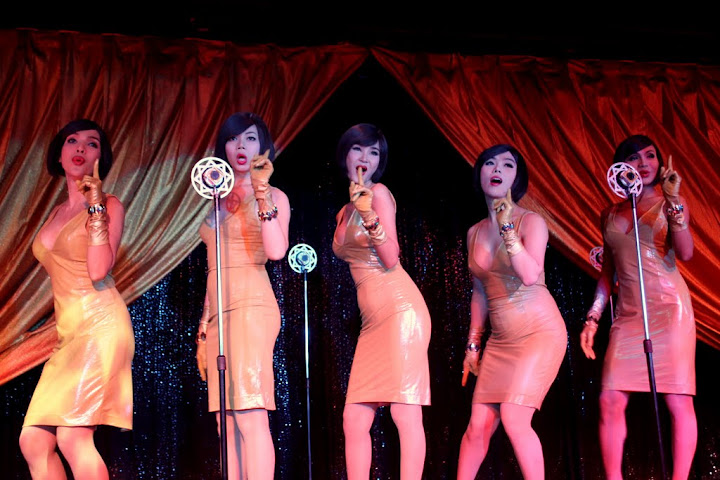
At the end of the night, we headed to the Caberet show that I went to about a month ago with my other friend from Vietnam. This time, we got front row seats, but even close up, many of the ladyboys looked genuinely like women!


Wat Arun


Ladyboy Cabaret

Thursday, September 1, 2011

Day 84 - Bagan Temples Part 2

I decided to take another route today through Bagan to see some more temples. It was one of the less traveled routes south of Nyaung U and through some of the more difficult and dusty dirt roads. I must have seen only 3 other tourists on bikes cycling through the trails, one of whom I met on the boat ride from Pokkoku to Bagan. This would be the third time in three days that I saw him at a random temple!

I started my biking trek at noon, probably the worst time to start as the sun was bright and the sky was cloudless today compared to yesterday. It was quite a workout, although this was all alleviated by random stops in the temples, where the air was cooler and the breeze flowed through the passages.

After seeing temple after temple, I arrived at a small village called Min Nan Thu. The only electricity they had in the village was powered through batteries similar to those used in cars. The villagers were friendly and one of the men asked if I was interested in purchasing some bronzeware. I told him it would be too heavy to carry around, so he asked if I had any extra tee-shirts to barter with. I asked him why everyone seemed to want tee-shirts and he explained that Myanmar produced bad quality tee-shirts and everyone wanted clothing outside of the country since it would last longer and wouldn't stretch out so quickly.

I was given a tour of the village, where much of it is self-sustaining. They make their own cotton and clothing, sesame and peanut oils, horse-cart wheels, and cigars among other things. The main crops they cultivate are peanuts, sesame, and various legumes.

At around 6:30pm, I decided to head back to the last temple I visited yesterday so that I could catch the sunset. It was anti-climatic since the sky was full of clouds in the distance near the horizon, so there wasn't much of a sunset to see. I met my sand-painting friend again and he said:

“My friend, the sun is going down so my prices are going down!”

I jokingly asked him if it would be free at around midnight and he replied:

“Price goes back up because the moon goes up!”

He later explained that the sunset hasn't been up to par lately because there hasn't been much rain in the area, which has also affected their farming.

He successfully sold a sand painting today, after 4 days of nothing, so that was a good way to end the day, although it would have been better if he had sold more. I asked him why he didn't become a motorbike tourguide since he had a motorbike and was a very personable and talkative individual, but he said that the government made it illegal for any foreigner to ride a motorbike in the city. I find that ridiculous, since it limits his opportunity to make some money on a talent he obviously has. It might be to limit how much access foreigners have to the country, but it ends up hurting the locals as well. I took a motorbike in Mandalay, but he said it was still illegal for me to do so...

We parted ways at the end of the night, but he said:
“See You Later Alligator!”

Instead of “Goodbye” because he hoped to see me again either in Bagan in a year, or at the White House in the United States... I wish him the best of luck and to hope to meet with him again.


Making Cotton

...and Cigars


Nearing Sunset in Bagan

Day 83 - Bagan Temples Part 1

There are two popular ways to view the temples in Bagan – either by horsecart with a tourguide or by bicycle. I opted to rent a bicycle so that I could go at my own pace, and because I was running out of Myanmar Kyat currency.

There are three sections of Bagan to explore – Nyaung U, Old Bagan, and New Bagan. Most of the more popular temples are situated near Old Bagan, which used to be where many of the locals lived before they were forced to relocate to New Bagan by the government when it was developing tourism.

I decided to take the popular route from Nyaung U to Old Bagan, stopping by whatever temples that caught my eye. Many of the temples have “key-keepers” who take care of the temples and hold the keys to the gates at the entrances to the temples. I found most of the locals to be extremely friendly, being tour guides when I entered each temple. Of course, they also wanted to try and sell me some of the merchandise that they had, ranging from lacquerware to sand paintings to tee-shirts. I didn't find it to be too distracting as their friendly demeanor made up for it.

Many of the temples had upper levels that weren't accessable due to restrictions by the government, but I did come across some that I was able to climb up. Once up top, the view was even more incredible, with thousands of temples sprawled across the small city in every direction. The terrain was flat, so there wasn't any sort of obstruction of my view of the many temples surrounding me.

Most of the temples were built in the 13th century, and many of the paintings are still originals inside. Some of the Buddha statues have had to be restored though, and there was a major earthquake in the 20th century that destroyed many of the temples completely.

The city of Bagan is one of the biggest tourist draws in Myanmar, but many of the temples I visited were empty. Near the end of the day, I settled on one of the temples that I could climb and just enjoyed the moment by myself for the next couple of hours. While there, a sand-painting seller came to the temple to try and sell me some of his paintings. He was a humorous, and good-natured salesman and we had a chat about the country, all while he cracked jokes.

After telling him I wasn't interested in buying the paintings, he said:
“OK, I give you present (sand painting), and you give me present ($$$)”

After telling him that I had already heard so many people saying their would give a “great price” for the paintings, he said:
“OK, I give you Wonderful price instead!”

He asked me if I was happy, and I replied that I was just “OK”, so he said:
“If you were happy, I sell for $15, but since you are just 'OK', I give you discount!”

He was pretty open about his dislike of the government. He said that he was only able to talk about it so openly on the tops of these temples, and if he said anything in the streets, he'd be handcuffed and led to prison. I asked him if he participated in the protests in 2007 and he said he protested everyday...but “in his dreams”. He said most of the money that was made in Myanmar ends up in the governments' pockets and in their families' pockets.

There aren't any private of government jobs in Bagan and most of the villagers have had to resort to selling merchandise to tourists to make any sort of income. You could either own a restaurant, work at a hotel, be a horse-cart driver, or sell merchandise. There isn't enough restaurant or hotel work, so the only other feasible way of making any money is through souvenir sales. And tourism has waned in the past couple of years, starting with the protests in 2007, and then a cyclone that swept through the country in 2008, then the protests in Thailand that closed down the airport for a while (Bangkok is one of the most popular cities to fly to Myanmar), and now the US Dollar is not worth much in exchange with the Kyat... It's a pretty depressing scenario.

But this young 22-year old salesman continued to be in good spirits throughout our conversation, and I could tell he got through the struggle by cracking jokes and talking a lot. There were times when he did get serious and I knew he hurt inside, telling me how hard it is to sell a painting, and how he'd come home and his mom would ask him how his day went, and how his silence was enough of an answer for her to know that he was unsuccessful for the day. He said most people made around 40K kyat each month, and if he were to move to Yangon, where the opportunities were better, that he would make around 60K kyat. This was better, but it would only be enough to support himself in the city, and he would be somewhere where he couldn't take care of his family or see his friends, so this wasn't an option.

It's times like these that make me think about how these people survive here...The government doesn't seem to care enough about its people to make the living conditions better, or to provide jobs, and internationally, most countries have sanctions that prevent any sort of business to enter the country that would help the locals. He said the key to everything was with China. The country has strong ties with Myanmar, and that is where the country gets most of its support. If China put some sort of pressure on the government to change things around, maybe things would be better... a sobering thought, all of this.


Wednesday, August 31, 2011

Day 82 - Pokkuku to Bagan


Decided to take the scenic river route on my way to the city of Bagan down the massive Ayeyarwady River. I took another local bus from Monywa to Pokkoku, which thankfully only took 2 hours since there weren't as many stops to pick up more locals.

Pokkoku is best known as the city that initially started the monk protests in 2007. They are also known for their tobacco and thanakha (sandalwood powder make-up) production. I didn't get a chance to explore the city, as I took a motorbike straight to the jetty.

I ended up being about 3 hours too early, so I sat around and had some tea and lunch, chatting with some of the locals about their traditions of marriage and whatnot. The area was very poor, and people kept asking for shampoo for some reason. I think that's the hot item these days. Others were selling blankets or at least willing to trade us for tee-shirts or other items we had in our backpacks.

The boat ride was pleasant, but there wasn't much to see along the river. The only thing I can really note is how wide and massive the river is. It was probably the biggest river I've rode along on a boat.

Arriving at Bagan was beautiful as you could begin to see some of the temples along the cliffs, waiting to be devoured by the river as the cliff slowly eroded.

After settling into my motel room, I rented a bike to explore the town. I headed to one of the biggest pagodas, the Shwezigon Pagoda, and along the way, I saw some small temples just outside one of the villages to climb and explore. It must be something to have some ancient temples that are hundreds of years old, right outside of your village.

I rode my bike around the village, just seeing the way the people lived. Some monks were playing soccer, mothers were walking around with their babies, and other boys were playing with rattan balls.


Along the Ayeyarwady River


Shwezigon Pagoda

Friday, July 29, 2011

Day 60 - Motorbiking in Chiang Mai

I decided to rent the motorbike for another day since it is just so convenient to have one while in this city. I didn't have any real set plans on what to do for the day, but figured I would somehow stumble on exciting things to see.

I went to a restaurant recommended by my new CS friend. It was called Huan Penh and served authentic Northern Thai dishes. I was so hungry (eyes bigger than my stomach) and ordered three different plates. The dishes were small enough, and I almost finished everything!

Near the restaurant was another Wat, Wat Phra Sing that I visited. About a hundred or so slippers lined the steps to the entrance of the Wat and inside, the temple was filled with monks chanting and meditating. It was such an incredible sight to see.

I looked over my Thailand guidebook to see what the nearest cities were, because I wanted to just drive around and cover a decent amount of the highway. I drove to a couple cities about 10km outside of Chiang Mai called Bo Sang and San Kamphaeng. The cities is known for it's handicraft villages, which made various items like umbrellas, silverware, lacquerware, and teak furniture. It was slightly raining on my way back to Chiang Mai, but going 60kmph, it was painful, as the rain hit my face and body.

At the end of the night, I headed to the Night Bazaar to check out the merchandise again, before taking another drive around the city, this time getting lost and stuck on a superhighway about 1km outside of Chiang Mai. I was stopped by the Thai police at a random checkpoint probably because I stood out by my unnatural driving. They helped me find my way back luckily and didn't give me any trouble...

Huan Penh - Kao Soy, Kanom Jen, and Northern Style Pork Sausages

Wat Phra Sing

Wat Phra Sing

Bo Sang Umbrellas

Thursday, July 28, 2011

Day 59 – Getting Spiritual in Chiang Mai

Taking advice from other travelers, I decided to rent a motorbike and head to Doi Suthep, a forested mountain 1,601m tall and 16km from Chiang Mai. At the top of the mountain sits Wat Phra That Doi Suthep, one of the most famous temples in Northern Thailand. It took a while to get there because I kept getting lost, using a map given to me and asking locals how to get there. Many of the streets in Chiang Mai are one-way streets, and people drive on the left side of the road, so I was a little nervous about getting around. There definitely were a couple times when I found myself on the right side of the road, before quickly realizing that I was about to kill myself....

I found myself lost at the Chiang Mai University, but thankfully, most of the people there spoke English and I was able to drive through the campus and onto a main road, quite close to the bottom of the mountain.

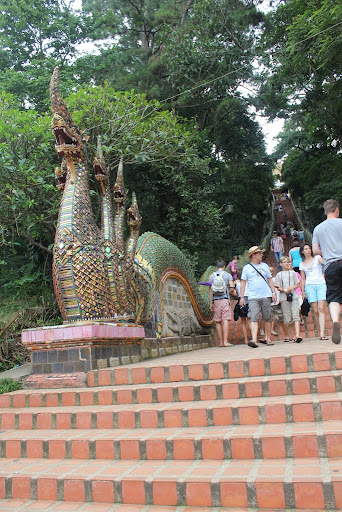
At the bottom of the temple was a 304-step staircase with nagas (dragons) on the sides used as handrails. Once at the top, I had to take off my shoes to enter. The temple was beautiful, with a gold-plated stupa right in the center, similar to what I had seen at the Grand Palace in Bangkok. The temple itself was not very big, was grand nonetheless because of the shiny gold shining brightly against the sunlight. I purchased some incense, a yellow candle, a stick of garlic, and a lotus flower as offerings to Buddha. I'm not too sure what the stick of garlic is used for, but I stuck it next to the burning incense...

On the outside of the temple were temple bells that people ring for good luck. There were also scenic views of all of Chiang Mai near the back of the temple. One unique monument that normally isn't seen at typical temples was the White Elephant Monument, which represented a white elephant that marched up the mountain, turned three times, and died. This was a signal to the king at the time to build a temple on top of the mountain.

Heading down the mountain, I stopped by a national park and took a mini hike through one of the trails, following signs written in Thai, in hopes that it would lead me somewhere interesting. I saw a small waterfall and ended up at another scenic view of Chiang Mai. I took another route down, where I met with a Thai man who happened to walk up the mountain, pray to Buddha, and walk back down. It took him 2.5 hours to get to the top. He said he was doing this, asking Buddha to grant his wishes in exchange for him walking up and down the mountain.

Afterwards, I biked back to the Old City in Chiang Mai and stopped at a bunch of temples. There are so many temples here, that you would expect to see at least one for every block you walked down. One of my favorites was Wat Chedi Luang, which had a main temple where I was able to see a group of monks meditating and chanting. In the back was another older temple that resembled something you would see at Angkor Wat. The entire area was so peaceful, and my experience was probably enhanced because it was overcast and the breeze was perfect at that time at dusk.

At the end of the night, I had dinner at an Anthony Bourdain recommended restaurant that served North Thailand Curries called Aroon Rai, and met up with a Couchsurfer at a Jazz Bar where there was a jam session that night. The bar was a mixture of Expats and locals, and I got some great advice on where to get some good food in Chaing Mai. I'm definitely going to check it out tomorrow.

Wat Chedi Luang

Steps to Wat Phra That Doi Suthep

Ringing Bells for Good Luck

Wat Phra That Doi Suthep

Wat Phra That Doi Suthep

Wat Phantao


Wat Phantao

Wat Chedi Luang

Wat Chedi Luang