Showing posts with label pagodas. Show all posts

Friday, September 2, 2011

Day 90 - Schwedagon Pagoda


I survived the 16 hour bus ride on an empty stomach and arrived in Yangon at around 5:30am, taking a shared taxi cab ride to the hotel. Luckily, they had a room available for me to doze off in for the next 5 hours since sleep was seldomly achieved on the entire bus ride.

I woke up to a rainy Yangon, which continued throughout the day, so very little was explored of the city. Plus, I had already been in this city at the beginning of my trip here. Given all the sights I had seen and all the cities I visited, this city has got to be my least favorite of all of them. It's the least clean, rainiest, and least easy to traverse on foot.

I decided I would visit the main attraction of the entire country, the place that clearly symbolizes all of Myanmar – the Shwedagon Pagoda. I decided I would give in and pay the $5 entrance fee to the government given all the details I learned throughout my trip. Five dollars really wouldn't help the government all that much, and I'm sure some of the money went to the maintenance of the Pagoda, since this was the MAIN ATTRACTION. Neglect of other sights could be excusable, but not at the Shwedagon Pagoda.

I took a taxi with my new Japanese friend, who I met on my three day trek in Kalaw. The pagoda was very impressive, not just in size, but in the glimmer that was created by the lights at night. It was almost as if I was in Hollywood, or Las Vegas, given the grandeur of the structure. I believe the entire center Pagoda was covered with a sheet of pure gold, which gave it a unique luster that was not seen at any of the numerous other pagodas I had seen throughout the country.

I found it fitting that I would come here to see this pagoda as the last attraction on my last full day in Myanmar.


Wednesday, August 31, 2011

Day 81 - Monywa


I took the local bus headed to Monywa in the morning. I was the only foreigner on the bus, and it took about 4 hours to get there (about 85 miles). The reason for the long ride was the fact that the bus stopped a million times to pick up passengers to stuff onto the bus with all their packages and belongings. Good thing I got a window seat so I wouldn't have to deal as much with the crowdiness. I'm pretty sure the bus shouldn't have to withstand the excess weight from the people and luggage, but that's the way to do things in Asia!

Monywa was a very small city, maybe even smaller than Pyin Oo Lwin, and a lot more peaceful. There were less vehicles on the road, which meant less honking all day. After checking into my hotel, I took a walk around the city, which didn't take too much of a toll since the weather was overcast and most of the city center was near the hotel.

I visited the Shwezigon Paya, which was a large religious site with numerous shrines and stupas. It has become one of my favorite places to visit so far in Myanmar because it was so peaceful and empty. It reminded me of Wat Chedi Luang in Chiang Mai. I guess my visit was enhanced due to the fact that this city isn't really one of the touristy stops. No other tourists were around, and no honking could be heard from inside the grounds. I spent about an hour and a half just sitting there, listening to music and watching people come and go as their stopped to pray.

After dinner, I decided to come back again to see it at night, enhanced by the artificial light, which made the stupas glimmer even greater than during the day. More people were there at night. I suppose it is a gathering site for people at the end of the day.

Tomorrow I head to Pokkoku by bus, before transferring to Bagan by boat down the Ayeyarwady River.


This was offered to me as a side for my lunch...not sure what I could possibly eat from it...


Monday, August 29, 2011

Day 77 – Waterfalls and Pagodas in Pyin Oo Lwin


I rented a bicycle to explore the small city again. While researching some of the sights to see, I decided to take a 4 mile ride northeast to see the Pwe Kauk Waterfalls and the Aung Htu Kan Tha Pagoda. The bike sucked. It was so difficult to ride up the slightest incline in the road, and this was probably the biggest workout I'd gotten this whole trip.

It took about 30 minutes to reach the pagoda, with random stops to ask the locals if I was headed in the right direction. According to legend, a 17-ton marble Buddha fell off a truck that was headed to China. After failed attempts to retrieve the Buddha, the pagoda was built and the Buddha raised because locals believed it belonged in Myanmar.

I reached the Pwe Kauk Waterfalls by around 1pm. It is a popular spot for locals to take a swim in the waters and is situated in a nicely forested area with a couple of trails to walk through, a couple crossbridges to walk across, and a water-powered carousel to ride.

The most painful part of the day was heading back to the hotel, as the sun decided to peek out from the clouds while I sweated my ass off riding a bike with a loose handle bar. I stopped a couple times to grab a beer and some ice cream to cool off and rest my legs.

While I planned to see the Botanical Gardens, I got lost trying to locate it on my Lonely Planet map, so I decided to skip it since it was already so late in the day and the gardens closed at 6pm.

Tomorrow I head to Hsipaw by train. Apparently, there has been fighting on the main road from Pyin Oo Lwin to Hsipaw in the past 5 days and the receptionist at the hotel had advised me to either take the train or head back to Mandalay by bus.

Pwe Kauk Waterfalls

Aung Htu Kan Tha Pagoda


Shan Noodles

Tuesday, August 23, 2011

Day 75 - Outside Mandalay

I spent the entire day on the back of a motorbike exploring three cities outside of Mandalay – Amarapura, Inway (Ava), and Sagaing.

The tourguide first took me to some of the sights in Mandalay, including Shwe In Bin Kyaung, a monastery build completely of teak wood, and Mahamuni Paya, which has a 13-ft Buddha in the center that has been continuously covered in gold paper leaves by the locals as they pray. The Buddha is said to be covered in up to 6-inches of gold over the span of over a hundred year. All of the statue is covered except for the face, which is kept completely clean. Women are not allowed in the inner chamber of the Paya and are not allowed to apply gold leaf to the Buddha.

We headed to Amarapura next, which is considered the royal ancient capital city of Myanmar. We stopped by a couple temples before visiting the Mahagandhayon Monastery, which is home to thousands of monks, including many young, novice monks robed in white. Some of the monks are only there for the span of their studies while others stay there indefinitely. We were lucky enough to arrive right before the almsgiving ceremony, which occurs everyday at around 10:15am when all the monks line up on the street to collect food from the volunteers who help cook for them. This is their only meal of the day.

Afterwards, we headed to one of the most famous sights in Amarapura, the U Bein Bridge - a 1,300 yard long teak footbridge used by the locals to cross the Taungthaman Lake. The rains and winds presented a challege as I watched every step I took down the bridge, some of the steps loose.

The next city we traveled to was Inwa, which required a boat ride across the river to reach. I met up with a Dutch man who happened to also be touring on motorbike and we explored the city together, avoiding some of the fees that were imposed on foreigners. The city itself was nothing too special – just more pagodas and stupas, and a leaning clock tower.

After lunch, we headed to Sagaing, which is home to about 500 stupas all within the hills of the city. We headed up Sagaing Hill, which was my exercise for the day. At the top were breathtaking views of the entire city, where you could see the hundreds of stupas scattered throughout the city. I can't believe how many stupas there are in this city. I thought Chiang Mai was incredible with it's many religious sites, but I think this city (and country) surpass it.

We headed back to Mandalay in the afternoon, where my tourguide helped me plan the rest of my 2-3 weeks in this country. It will be interesting figuring out how to get from one place to another, but that's all a part of the excitement.

I ended the night meeting up with the Dutch guy I met at Inwa and we had dinner and a couple beers, discussing some of the ridiculous stories of scamming that we had experienced and that he had heard from other people he met. It seems that white people have a lot more trouble with scammers than I do. I don't know if it's because locals view them as more vulnerable and gullible (or wealthier?), or maybe they are just easier to target than I am. It's riskier for them, but they have better stories to tell in the end.


Mahagandhayon Monastery - Alms Ceremony


Novice Monks eating around 10:30am


Mahamuni Paya (and the Men who are allowed to pray in the inner chamber)


Myanmar Marionettes

The meticulous craft of silk-making

Pagoda in Amarapura
U-Bein Bridge

Sagaing Hill

Inwa Bridge

Monday, August 22, 2011

Day 72 - Conversations with Students


It has intermittenly rained throughout my travels in SE Asia, but it has finally poured here in Myanmar. Most of the early day was spent indoors, escaping the rain and planning the day.

I would take a walking tour of Downtown Yangon in the afternoon, guided by my Lonely Planet, which was one of the few Myanmar travel guides I could find in the book store back home. There were different routes you could take around the country, depending on how adventurous you were, how much money you wanted to spend, how long you were in the country, and whether or not you cared about supporting the government with your money.

I initially decided to try to avoid as many governmental fees as I could, but as I looked through the guidebook and travel resources online, I found it difficult to avoid some of the fees when you visited some of the bigger cities with some of the more exciting things to see. We'll see as I go further along on this trip since everything is slightly unplanned at the moment.

The first stop on the tour was the over 2,000 year old Sule Paya (Pagoda) right smack in the middle of downtown Yangon. The temple was recommended by Lonely Planet as an alternative to the most famous temple in Yangon, the Shwedagon Paya, which required a $5 governmental entrance fee. Upon entrance, I was asked to donate money when I took off my shoes to enter. I asked if the money went directly to the restoration and maintenance of the temple or to the government. It was hard to understand them, so I only contributed 200 kyat ($0.25). This made me think whether I would have to second guess every single payment I made to see anything here...

Walking around the temple, I met with three university students who were on vacation from school. They had just come from an orphanage they were volunteering at and were exploring the city as well. I told them that I was from the United States and they immediately told me how lucky I was... They each had different majors, and I asked them what they would do after they finished university. They said they'd have a hard time finding a job afterwards. One of them wanted to be a journalist in Chiang Mai, but knew he'd probably have to work as a taxi driver after university. To be a journalist would mean that he would have to escape across the border to Chiang Mai, instead of being a pseudo-journalist (or propagandist) in Myanmar. I asked why they would spend so much money on an education if it would be hard to find a job anyways, and they said it was because it interested them to be educated, despite the difficulties afterwards. The fees for them were 30,000 kyat ($40 USD) per month.

We decided to meet for beers after I took a tour of the city. I asked them if I could take a picture of them, and they refused, saying that they were part of the September 2007 monk protests and were afraid of the repercussions if the government saw the pictures or that they were speaking with me. Some of them showed me their scars, which they got after being hit by police batons during the protests.

I walked through the city for the next couple hours, stopping by a catholic church, mosque, and Hindu temple. You could really tell how diverse this city was because of this. All of these religious centers were all within walking distance of each other in the middle of the city.

I stopped by the Strand Hotel, which was a luxury hotel with British Colonial elements throughout the hotel. At the front of the hotel were little kids trying to sell postcards. I ended up purchasiing 10 of them. The little kids asked me what my name was, how old I was, and where I was from. Upon answering that I was from America, they would each recite the same thing to be at different times. “Oh? America? Basketball. Michael Jordan.” I think they have a little spiel everytime they meet people from different countries. They told me they were hungry, and I joked that I was hungry too. I decided to buy three of them a meal, but instead of the meal, they wanted ice cream! I told them it was not healthy and that they should eat vegetables, but they insisted on ice cream, so we went to the local grocery shop and they chose their ice creams.

At the end of the tour, I went back to meet with the students and we stopped by a local restaurant to have dinner and beers. They told me a lot of interesting tidbits about the political climate and history of Myanmar (They don't call the country “Burma” themselves).

The country itself was ruled by the British until 1948, when the country gained independence. The military took control of the country in 1962 and had continued to take control of the country until recently, when the country held elections and is now a so-called “democracy.” The students believe that the country is slowly headed in the right direction, and hope to see more changed in the coming years.

I asked them why the rate of exchange of the USD was so low, and they associated it with the Chinese bringing in USD to buy gemstones recently. I also asked about how they felt about me trying to dodge the governmental fees to visit some of the sites in the country. They told me that the money that the government receives from tourism is so small compared to the dirty money they collect from selling gemstones, that it didn't really matter if I did contribute to the government. They appreciated the thought, but told me that it would be fine to pay some of the fees if I came across them.

The three of them were also arrested during the September 2007 monk protests, which initially began due to the sudden increase in prices of local transportation and food, among other things. The government gave no explanation for these increases. They served terms ranging from a couple months to a couple years, one of which worked in the rice fields. They also told me stories of the torture tactics of the government, including water droplet torture, where the prisoner sits as a single droplet of water drips on their head for hours. I didn't think this was torture, but they explained that you could get incredible migrains from this type of torture.

I also asked if there was still forced labor in the country, and they explained that there was, and most of them were prisoners, but stometimes, the government take people from the streets at night, which is one of the reasons why people are home by 10pm. Such an enlightening, but intense conversation to end the night! I was surprised they were so open to speak to me about it, but maybe things really will change for the better.


Sule Paya


"Water Fountains" throughout the city

Thursday, July 7, 2011

Day 35 - Perfume Pagoda

Arrived back in rainy Hanoi at around 6am without a hotel. I was actually supposed to take a Halong Bay tour for 2 days and 1 night starting today, but the tour was cancelled due to the incoming storm in the area. This was a major bummer since most people recommended that I go see the caves in the area, and I wouldn't be able to reschedule since I already booked my flights to the Philippines by then..

I ended up booking a one-day tour to see the Perfume Pagoda 100km outside of Hanoi in the Ha Tay Province. It is a major religious site for the Buddhists in the area. It consists of many different Pagodas within the grottoes in the area. Like the annual trek to Mecca for Jews, many Vietnamese Buddhists pay a visit in large numbers to the Perfume Pagoda in the SpringTime. The rivers are flooded with metal boats taking them to the shrines.

Since it was (very) low season, we were able to take these boats to the Perfume Pagoda in peace, without having to fight for space in these low boats, that could easily tip over with the slightest shift in weight from one side to the other.

I met two Californians from Simi Valley on the tour. It was funny because I keep trying to guess where people are from when they speak English, and I couldn't tell if they were from the United States. I think I'm overthinking it now, since I still can't tell an Aussie accent from an English. Maybe I just need to hear it more...

Since it was rainy, we were able to take some pretty cool pictures of the waters overflowing throughout the Thien Tru Pagoda (Pagoda Leading to Heaven). Unfortunately, I was not wearing the proper clothing to enter the temples, so I was only able to take shots outside.

After that, we took a cable car up the mountains to the Huong Tich Cave, which was a huge cave that the Buddhists came to visit. The Pagoda in the area is called the Pagoda of the Perfume Vestige. Since I didn't get to see the caves of Halong Bay, I think this cave somewhat made up for what I missed. It was probably the biggest cave I'd ever been in, and hopefully I can top this sometime and somewhere else on my journey.

On the boat ride back, I talked with one of the tourmates from California who competes in a sport called “Adventure Racing.” You basically are racing to get from one location to the finish line, using only a compass and a topographical map, without the use of a phone or GPS. There aren't many other rules, and you can bring money to trade with the people you meet. Some of these races last for days, and the more professional players compete in some of the most exciting places around the world. Anything can happen, and some people have had to get evacuated because of injury or sickness. In fact, one of his friends ended up contracting a disease of some sort that the doctors don't know the origins of, and a tumor continuously grows on his body, which he has to drain every so often. I asked him how you can call for help in the event of an emergency, and he says that most people purchase some sort of a GPS signal that you can press to call for help.

His brother lives in HCMC and works for Nike, which naturally lead to my curiousity in the labor conditions of the workers there. He explained, at least from his brothers' accounts, that Nike has vastly improved their record on labor conditions for workers, and that currently, Toyota is being more closely criticized (or maybe Apple in China should be, given the number of suicides in the factories). In the past, it was hard to be accountable for the conditions of workers since Nike purchased different products and manufacturing supplies from different companies/factories and was less knowledgable about how these workers were being treated. Now, there is a lot more pressure from Nike to these suppliers to maintain proper working conditions for the workers. I asked what the wages for these workers were, and the tourmate said it was camparable to what the people living in the areas were making, and although it may seem like a “sweatshop” wage to Americans, it was a decent wage for the people living here. You wonder why everything is manufactured in countries all over Asia...

After we arrived back in Hanoi, I took the opportunity to head to Hanoi Cinematheque again to catch the latest movie. This time, it was Biutiful starring Javier Bardem and directed by Alejandro Gonzalez Inarritu. It was a bleak view of the life of a man living in Spain and finding out he is dying from cancer. Probably the weakest of the 4 films by Alejandro Gonzalez Inarritu I'd seen (my favorite being 21 Grams)...

Boat Ride to the Grottoes and Pagodas

Boat Ride to the Grottoes and Pagodas

Thien Tru Pagoda

Thien Tru Pagoda

Cable Cars to Huong Tich Cave

Huong Tich Cave

Huong Tich Cave - It sort of felt like I was in line to ride Indiana Jones at Disneyland

Huong Tich Cave


Ha Tay Province

Sunday, June 19, 2011

Day 26 - Hue Ancient City and Citadel

Took another early sleeper bus ride from Hoi An to Hue, which took about 4 hours. I pre-booked a hotel on expedia just to save the hassle of dealing with all the motorbike drivers hounding you for a ride the moment you exit the bus. It wasn't too expensive, so it saved me a little stress and gave me a lot more luxury. I don't know if it's psychological, but I just assume the rooms are cleaner because I'm paying more than $5 to $7...

Hue was the former capital of Vietnam before Ho Chi Minh and the Communist Party took over the country and relocated the capital to Saigon. The last dynasty before this takeover was the Nguyen Dynasty, probably one of the most common Vietnamese Surnames in the country (or at least Little Saigon?). The family's ruling lasted 13 generations over the span of 143 years and they are remembered all over the city with mausoleums, tombs, and an Imperial City called the Citadel, which included a Forbidden City that the emperor and a select few people were only allowed to set foot in.

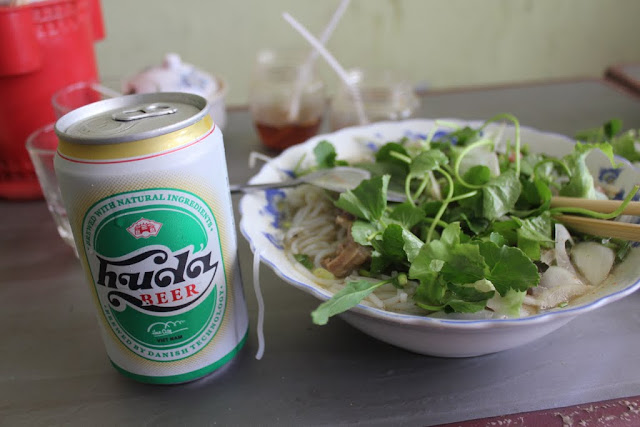
I gave into a tour again. Not 1 hour after checking into my hotel and roaming the streets looking for food (I tried one of the Hue specialties - Bun Bo Hue), I ended up booking a full day tour, which I would start today and finish tomorrow. Bad idea....as I should have rested from the bus ride and just relaxed in the city. I was tired the whole time, and didn't pay as much attention to the tour guide.

We walked through the Citadel, which was the former Imperial City for the Nguyen Emperor. The entire area was surrounded by brick walls and water to prevent attacks. Inside the city were palaces, theatres, libraries, and living quarters, among other things. Much of the city was destroyed during the war, and is currently being restored. The restored structures will be complete replicas, which takes away from the authenticity of the site. I almost thing it would be better to leave it alone, or at least try to use some of the vestiges in the replicas.

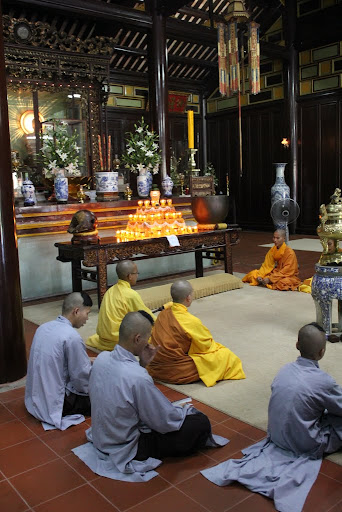
Afterwards, we headed to the Thien Mu Pagoda, which is recognized by a seven-story octagonal tower in the front. We were there during one of the Monk's chanting sessions, which was very mesmorizing to watch. What I found interesting was the way some of the younger monks cut their hair. Normally I'm used to seeing Monks with their hair fully shaved, but these monks had only their bangs unshaved. We stayed there for a short period before heading on yet another boat ride down the Perfume River. Both my travel books for Vietnam recommended a boat trip down the Perfume River...but again, I was left underwhelmed as there was nothing going on in the river! Maybe it's just not the right season?

At the end of the night, I met up with two CSers who lived in Hue and had dinner and coffee with them. They took me to a restaurant to try another Hue speciality - Nem Lui, which has become yet another favorite dish of mine. We talked a little about the education and interests of Vietnamese students. Both of them spoke very good English. One of them wanted to study English literature and one day become an interpreter or translator. The other wanted to be a secretary or work in tourism. What I found very surprising from our conversations was that most Vietnamese students were not interested in history, politics, or law. They were more interested in economics and English. There's so much history within the country that I would think the students would be fascinated by it all, but apparently that isn't so. They said that most students are bored by it all.

We also discussed the aspirations of these students. Most people who can speak a foreign language have desires to either travel outside the country, or relocate to another country so that they can make more money. They believe this is the case because with the skill of another language is greater access to general knowledge of everything outside of Vietnam. They are more aware of the possibilities than other Vietnamese students who aren't as good at a foreign language.

Of course, getting a Visa into another country is a difficult, timely, and expensive process for these students. For one, the U.S. does not want to make it easy for these students to come to the country, even with a sponsor or relatives living there because they know that these students will most likely stay in the country. The application process is difficult. To top it all off, you basically have to pay your way just to get an interview for a Visa. There are so many people in between you and the American interviewer, that you have to save up a ton of money to gain access. One of the CSers friends had to pay around $10,000 USD just to get a 2-3 year Visa to Canada...

We spent the rest of the night on more trivial topics. I taught them some new English idioms like "Its raining cats and dogs" or "Don't let the cat out of the bag" and one of them interviewed me for 15 minutes for her English class about my experiences in Vietnam so far. 

Bun Bo Hue and the local Hue Beer, Huda

Citadel - Cot Co (Flag Tower)

Citadel - Ngo Mon Gate

Citadel - View from inside looking towards the front

Thien Mu Pagoda

Thien Mu Pagoda

Monks chanting inside the Thien Mu Pagoda

A young monk deep in chant

Nem Lui - DIY spring rolls

My new friends, Thanh and Mimi